
How to Fix a Wrong Khata Entry (Why Reversals Beat Deletes)
20 August 2026 · LenDen Team · 6 min read
Fix a wrong entry by posting a correcting entry, not by deleting the original. The balance ends up identical either way — the difference is whether your khata can still explain what happened when someone questions the total three months later.
That difference is the entire point of keeping a ledger rather than a running total on a slip of paper.
The short version
- Correct with a new dated entry; do not erase the old one.
- A wrong direction shifts the balance by twice the amount — check for that first.
- Wrong party means two wrong balances. Fix both, same day, same note.
- Note why on every correction. "Reverses entry of 12 Aug" is enough.
- Tell the party if the wrong balance was ever quoted to them.
Why deleting is the wrong instinct
Deleting feels clean. The bad number disappears, the balance is right, nothing looks wrong.
The problem arrives later. A customer says "I paid you ₹500 in July." You look at your khata and there is no ₹500 — because you deleted a mis-entered one and the real payment was never re-entered, or because you deleted the right one by mistake. Either way you now have no record of the event, and no way to reconstruct what you did or why.
A correcting entry keeps both facts: that something was recorded, and that it was subsequently put right. It costs one extra line and it makes the ledger able to answer questions.
There is also a discipline argument. If corrections are invisible, nothing stops a balance being quietly adjusted whenever it looks inconvenient — including by a staff member with access. A ledger where every change leaves a trace is a ledger you can hand to an accountant, show a partner, or put in front of a party.
The one exception
If you mis-tap and catch it in the same breath — before the sheet closes, before anyone sees a balance — just delete it. A correcting entry for something that existed for four seconds is noise. The rule applies from the moment the wrong number could have been read or acted upon.
The four mistakes, and the fix for each
1. Wrong amount
You entered ₹1,400; it should have been ₹1,040.
Fix: post the difference in the opposite direction, or reverse and re-enter. For a ₹360 overstatement, a ₹360 received entry noted "corrects overstated amount on 6 Aug entry" brings the balance right.
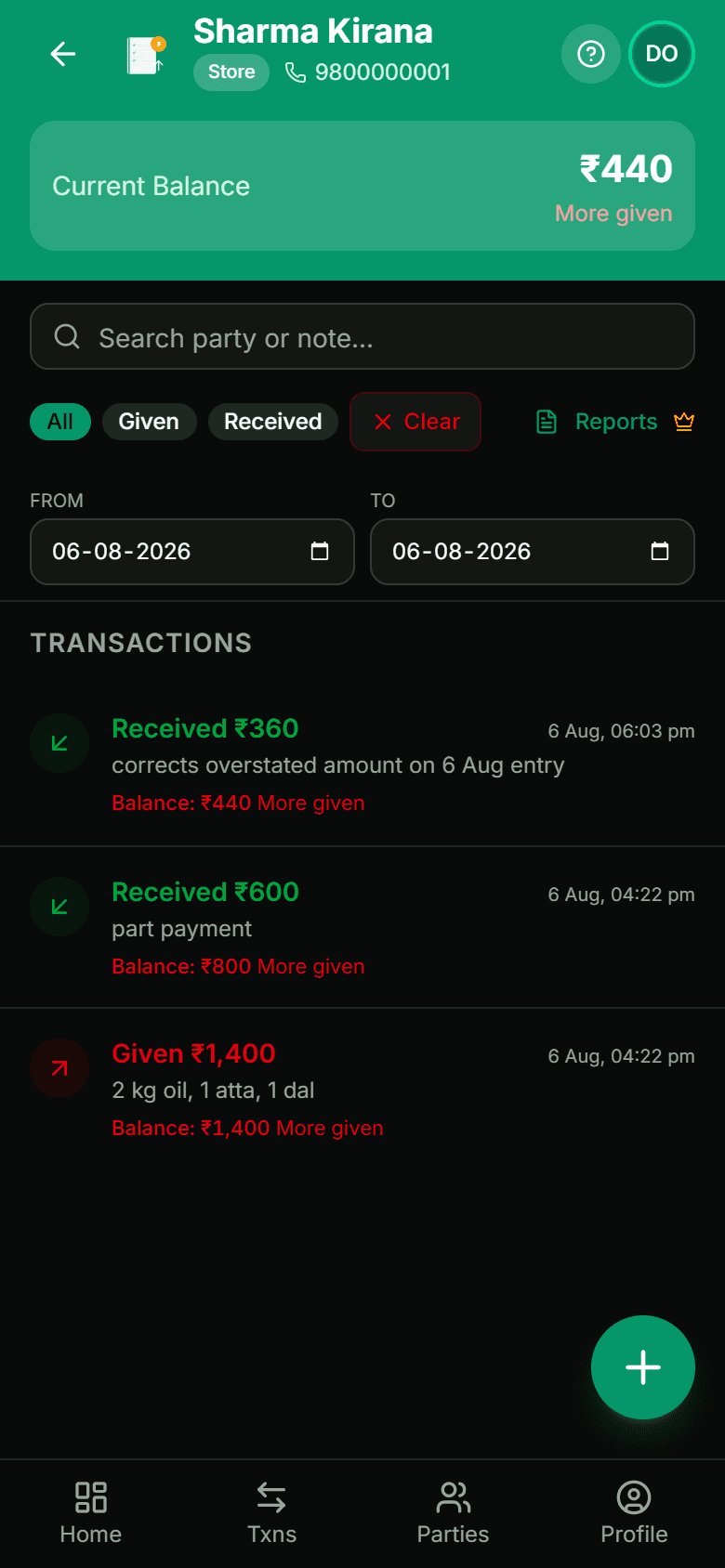
Reverse-and-re-enter is clearer for large differences: a ₹1,400 received to cancel, then a fresh ₹1,040 given. Three lines instead of two, but anyone reading it can see exactly what the intended entry was.
2. Wrong direction
You recorded ₹750 as given when the party actually paid you ₹750.
Fix: this needs ₹1,500 of correction, not ₹750 — and that catches people out. You must undo the wrong ₹750 given and record the real ₹750 received. Post a ₹1,500 received entry noted "corrects direction of entry dated 12 Aug", or reverse the original and re-enter properly.
This is the error worth learning to recognise. Whenever a balance is off by exactly twice a familiar amount, look for a flipped direction first — it is almost always that.
3. Wrong party
The entry is correct but sitting on the wrong person, usually two parties with the same first name.
Fix: two entries, both today. Reverse it on the party who should not have it, then enter it on the party who should. Put the same note on both — "moved to Ramesh (Gali 4), entered in error" — so the pair is obviously one action.
Then fix the root cause: rename the parties so they cannot be confused again. "Ramesh (medical shop)" and "Ramesh (Gali 4)" takes ten seconds and prevents the recurrence.
Remember this error produces two wrong balances. If one party is over by ₹900, another is under by ₹900 — worth checking, because you may have found only half the problem.
4. Duplicate
The same amount twice, minutes apart, from a double-tap or a slow network.
Fix: reverse the duplicate — not the original — with a note saying so. Keeping the earlier one and cancelling the later keeps the timeline sensible.
What every correction needs
Three things, or it is not really a correction:
- Today's date, not the date of the original. The correction happened now; backdating it hides when you noticed.
- A note naming what it fixes. "Reverses entry of 12 Aug — wrong party" is sufficient. In six months this note is the only thing that will make the pair intelligible.
- The amount that makes the balance correct — which, for a direction error, is double.
After posting, read the running balance down the party's ledger to confirm it lands where you expect. That column is the check, and using it is covered in reading a party ledger.
When the wrong number reached the customer
If a party was ever told the wrong balance — quoted it at the counter, sent a statement, or paid against it — the accounting fix is only half the job.
Tell them, and show them. "Sharma ji, meri galti thi — ₹1,400 likh diya tha, actual ₹1,040 tha. Correct kar diya hai, ab ₹440 baaki hai." Then send the corrected statement.
Two reasons this matters more than it seems. First, if they paid on the wrong figure, they have overpaid, and an overpayment sitting unmentioned is the fastest way to lose a customer's trust permanently. Second, raising it yourself establishes that your khata gets corrected rather than adjusted — which is exactly the impression you want when a genuine dispute arrives later.
If they overpaid, the surplus sits as a credit against them and comes off the next purchase. Say that explicitly, because "we'll adjust it" without a number sounds like it will be forgotten.
Prevention, since most of these are avoidable
The four errors above have three root causes, and all three are fixable habits:
- Entering later, not at the counter. Entries reconstructed at closing time are where amounts get rounded, merged, and mis-directed. Enter while the customer is in front of you.
- Ambiguous party names. Add the shop, the area, anything. This single change eliminates the hardest-to-spot error.
- Not reading the note field. A note takes three seconds and turns every entry into something you can verify against a memory. "Goods" verifies nothing.
Those are the same habits that make the rest of a khata work, set out in how to keep a digital udhar khata. Corrections will still happen — everyone mis-taps. The aim is a ledger where the mistakes are visible, dated, and explained, because that is a ledger you can defend.
Frequently asked
- Should I ever just delete a wrong entry?
- Only if you catch it within seconds, before anyone has seen the balance and before the day closes — a genuine mis-tap that never meant anything. Anything older gets a correcting entry, because by then the wrong balance may already have been quoted to the party or acted on.
- What is a reversal?
- An equal and opposite entry that cancels the original. If you wrongly recorded ₹500 given, you post ₹500 received with a note saying it reverses that entry. The balance returns to correct and both lines stay visible.
- Won't reversals make my ledger messy?
- Slightly, and that is the trade. A ledger with a few visible corrections is more trustworthy than a tidy one that has been quietly edited — a customer disputing a total can be shown exactly what happened and when.
- How do I fix an entry against the wrong party?
- Two steps, same day: reverse it on the party who should not have it, then enter it on the party who should. Use the same note on both so the pair is obviously connected.
- What if the customer already paid based on the wrong balance?
- Correct the entry, then tell them, showing the statement. An overpayment sits as a credit against them and comes off their next purchase. Discovering it yourself and raising it first is what keeps the relationship intact.