
Reading a Party Ledger: Debit, Credit, and "Kitna Baaki"
19 August 2026 · LenDen Team · 6 min read
A party ledger answers one question — how much is outstanding, and how did it get there. Read it in three parts: the closing balance at the top, the direction of each entry, and the running balance beside every line that shows the total after it.
Once you can read the running balance column, finding an error takes seconds rather than an evening.
The short version
- Given = they owe you more. Received = they owe you less.
- The balance at the top is the sum of the entries, never a typed number.
- Every line shows the balance after it — that column is how you find errors.
- Read the label next to a balance, not just the figure. Direction matters.
- Debit and credit are the accountant's words for the same two directions.
The three parts of a ledger
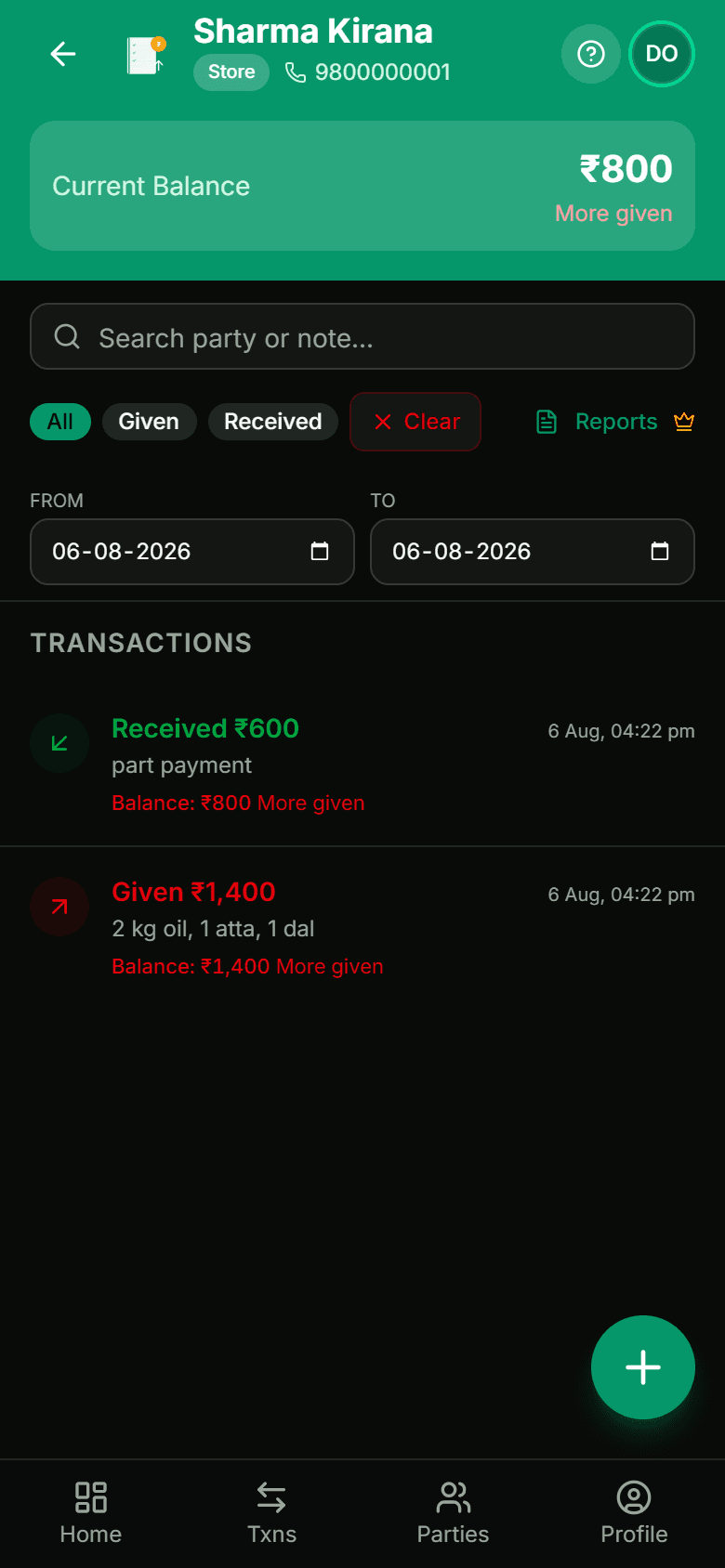
The header. Party name, type, phone, and the current balance with a label telling you which way round it is — here "More given", meaning they owe you.
The entries. Each one has a direction (given or received), an amount, a date and time, and whatever note you wrote. The note is why "2 kg oil, 1 atta, 1 dal" is worth three extra seconds at entry time.
The running balance. Beside each entry, the balance as it stood after that entry. In the example: the ₹1,400 given took the balance to ₹1,400; the ₹600 received brought it to ₹800.
That third part is the one most people skip, and it is the most useful.
Given and received, in plain terms
Two directions, and everything else is derived from them.
Given — you handed over goods or money on credit. The party now owes you more. Shown in red, because it is money out of your business.
Received — the party paid you. They owe you less. Shown in green.
The balance is simply all the givens minus all the receiveds. ₹1,400 − ₹600 = ₹800. No arithmetic on your side; the app sums the lines.
Read the label, not just the number
A balance of ₹4,600 means nothing on its own. "₹4,600 more received" and "₹4,600 more given" are opposite situations. With distributors you are often the one who owes, so the direction flips — always read the words next to the figure.
Where debit and credit come in
If your accountant uses debit and credit and it feels backwards, here is the mapping.
| Your words | Accountant's words | Meaning for you |
|---|---|---|
| Given | Debit to the party | They owe you more |
| Received | Credit to the party | They owe you less |
| Kitna baaki | Closing balance / receivable | What is outstanding today |
The reason it feels reversed is that an accountant describes the entry from the books' point of view, while you describe it from yours. Both are correct; they are the same event named from two seats. It is also why a bank statement's "credit" means money in for you — the bank is describing its own books, not yours.
You do not need the accounting words to run a shop. You need them when you hand records over, which is why good khata apps offer both a shopkeeper view and an accounting view of the same data. Neither changes the underlying entries — how to keep a digital udhar khata covers switching between them.
Using the running balance to find an error
This is the practical payoff, and it turns a vague "the total looks wrong" into a specific line.
Suppose a party's balance reads ₹3,400 and you are fairly sure it should be about ₹1,900. Do not re-add the column. Instead:
- Start at the oldest entry and read down the running balance.
- Find the first line where the balance stops matching your expectation. Up to that point the ledger and your memory agree.
- Look at that entry. The error is almost always one of four things.
The four:
- A duplicate — the same amount entered twice, often minutes apart, from double-tapping save.
- A wrong direction — a received entered as given. This shifts the balance by twice the amount, which is why a ₹750 mistake can look like a ₹1,500 discrepancy.
- A decimal or digit slip — ₹4,000 for ₹400, or ₹1,400 typed as ₹14,00.
- The wrong party — the entry is legitimate but sitting on someone with a similar name. This produces two wrong balances, so if one party is over by ₹900, check whether another is under by ₹900.
That last one is the argument for distinguishing party names properly at setup. "Ramesh (medical)" and "Ramesh (Gali 4)" prevent the error that is hardest to spot.
Once you have found it, fix it with a correcting entry rather than a deletion, so the ledger can still explain what happened. That is covered in how to fix a wrong khata entry.
The one property that makes a ledger trustworthy
Balances should be derived, never stored and edited.
If the app computes a balance by summing the entries every time, then the total and the history can never disagree. If it caches the total on the party record for speed, a backdated entry or a reversal can leave the cached figure out of step — and you will not know, because both numbers look equally confident.
The test is simple: add a transaction dated last week and see whether the balance updates correctly. If it does not, the number at the top of the ledger is an opinion.
This is also why an app that lets you type over a balance directly should worry you. There is no legitimate reason to edit a total; you edit entries, and the total follows. A khata whose numbers can drift is worse than a paper bahi khata, because paper at least does not pretend to have done the arithmetic for you.
Reading it as a habit
The ledger is worth opening for the three parties with the largest balances every week — not to do anything, just to read the trail.
You are looking for: entries you do not recognise, gaps where payments used to be regular and stopped, and balances creeping past the limit you set for that party. All three are visible in thirty seconds from the running balance column, and all three are much cheaper to act on early.
The wider system that this fits into — limits, same-day entries, day-7 reminders — is in the complete guide to managing udhaar. And if the numbers themselves are what you want to understand better, small shop bookkeeping covers how receivables connect to your actual profit.
Frequently asked
- What is the difference between debit and credit in a khata?
- In shopkeeper terms: a debit against a party means they owe you more, a credit means they owe you less. An accountant states the same thing from the books' point of view, which is why the words feel reversed when a bank uses them. If the wording confuses you, read the direction words — given and received — instead.
- Why does every entry show its own balance?
- So a total can be traced. If a party disputes ₹800, the per-entry running balance shows exactly which entry took them there and when. A single closing figure with no trail behind it is an assertion; a trail is evidence.
- My balance looks wrong. Where do I start?
- Read the running balance downwards until the number stops matching what you expect. The first line where it diverges is your error — usually a duplicate, a wrong direction, or a decimal slip. That is much faster than re-adding the whole column.
- What does a negative or opposite-coloured balance mean?
- It means the direction has flipped — you owe them rather than the reverse. This is normal with distributors, where you are usually the one paying. The label next to the number tells you which way round it is; do not read the figure alone.
- Does the app ever change a balance on its own?
- It should not, and this is worth checking in any khata app. A balance should only ever be the sum of its entries. If a total can change without a corresponding entry appearing, the number cannot be trusted.